#programmierung

Posts tagged programmierung

AnkhSVN 2.0 Subversion client for Visual Studio

I complained before that Visual Studio has no built in support for Subversion, as SVN is currently one of the most common source control choices for open source projects.

One commenter pointed me towards AnkhSVN as a source control provider, but I wasn't working on anything involving SVN so I didn't install AnkhSVN right away - I should have done!

AnkhSVN 2.0 is exactly what I was looking for!
I installed it and it integrated itself very nicely with Visual Studio. Not acting as a AddIn but as a source control provider similar to Visual Source Safe.
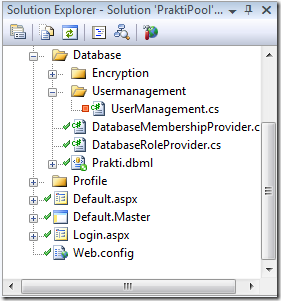
image

So it hooks itself into your solution explorer, showing you the file status within Visual Studio

You can open projects directly from Subversion, and the Pending Changes window helps in keeping track of what changes need to be committed to the SVN (never forget to commit your .csproj file after adding files to your project ;)).

Overall, AnkhSVN works very well and the UI is clean and does what you'd expect from your Subversion client, and it's good integration into Visual Studio helps. No more exception list hacking for file-based clients like Tortoise SVN.

As with most open source software, AnkhSVN is still work in progress, and I've already found some bugs. But if this project continues to evolve I think we have a really powerful tool at our hands!

So, if you want to try it for yourself (strongly suggested), go and grab the latest release (I suggest installing the daily build) from the AnkhSVN project site.
If you find any bugs while using the tool, please make sure to tell the developers. Their issue tracker sucks, you'll need to register and request access to the tracker (but they are pretty fast in granting access).

Read more →

Inline Styles aren't all that evil

Everyone who did some web stuff and had to do some HTML had fun with the style="" tag.
It's the simplest way to change the appearance of something and also very intuitive (right at the point where you want the change to happen). So, everyone of us is sometimes hacking some style="" stuff from time to time ;).

You usually continue to do so until the whole thing backlashes and you have absolutely unreadable code because every <div> tag is 3 lines long and you can't distinguish between style and markup.
So, that's the point where we all learned: Inline Styles are evil!

Now, while reading some RSS feeds today I discovered that inline styles aren't completely useless nowadays. Especially in times of RSS content syndication, sometimes it's very important to attach the style to the markup, so your markup remains readable at the external source.
Most RSS readers don't strip the inline CSS markup, and you may very well use this to format your feed accordingly. E.g. images that should be floated don't look good in a feed reader if they break the article they should illustrate, so attaching the "float: left; margin-right: 10px;" isn't too obscuring, but helps your readers a lot.

So, although inline styles really contradicts the DRY principle, sometimes it's cool to use them for syndication reasons.

Read more →

Precompiled deployment in ASP.NET

The usual deployment of as ASP.NET web app is just a basic FTP upload of everything you have in your solution. The whole aspx and aspx.cs stuff that you can then edit and change on the server.

All the source (except for class libraries) is fully available and visible on the server, so if your customer is like mine you're destined to see some self-patched applications appear over time.

This doesn't only hurt revenue, but it also brings some serious version issues when you get tasked with changes afterwards.

So, sometimes it's important to lock your customer out of their app (yeah, that sounds evil doesn't it?). And that is where ASP.NET has a neat feature in place called "Precompiled deployment".

image You just go into Visual Studio and select your Project, click Publish Web Site and follow the wizard.

You can select to directly deploy the page to a server via FTP etc, or to just put it onto your file system.

If you open the folder afterwards you will see that some files have gone missing :).


image

All .cs (or .vb) files are gone and a new (randomly named) library has appeared in your bin\ folder that contains a compiled version of your .cs files.

Also, you need to note that precompiling your application is something that will not significantly speed up your website performance. If you just deploy the .cs files to the server they will still get compiled to IL code and run just as fast as the precompiled version you deployed binary.
What get's speeded up is the startup process of your application, because compilation takes place when the first request gets served.

I guess it's safe to say that if you see a somewhat significant improvement in performance through precompiling, your app is somewhere broken or should be broken into smaller chunks. Compiling code shouldn't take long on today's hardware, and if you end up with folders with thousands of thousands of files, you're in trouble anyway. (The server compiles your .cs files per folder when the first request gets served)

Finally, although there is a compiled library out there doesn't mean your customer can't change it at all. He could still go out and decompile your dll, change his stuff and recompile it. But if he's that smart, he probably deserves to change it anyway.
(To really protect your IP you should look for Obfuscators)

Read more →

Do the simplest thing you can get away with

So, yesterday I was talking to a customer about a new project I will be developing over the next month or so.
And half way through the project (revamping a legacy system), I was asked if I could insert sorting into a statistical grid view.

I immediately started thinking about using a ASP.NET grid view control with sorting and paging capabilities enabled. But just before I could open my mouth, it hit me: Why in the heck should I do something that stupid?

My customer isn't only good at using Excel, these guys are traders! They probably know better how to do sorting in Excel than I know how to do it in ASP.NET!

So, because this grid was filled through some pretty complex selection criteria, why in the hell wasn't my first idea to simply give them a CSV list with all the data they need and let them do it themselves.

This solution isn't only superior for the customer, it's also much better for me because code you don't write can't break! Excel is giving my customer all the things he otherwise would demand from my application, with added benefits like pie charts and custom functions. Why should I even bother to take on this?

The smartest code is no code at all!

If you can get away without writing code, do it immediately. Every line you write less is one you don't have to care about later.

Read more →

Good design leads to problems

Bad design is in most cases the result of people not knowing better, and while I am constantly struggling to learn more about good architecture design I sometimes feel like: How in the hell can I ever make this work inside of ASP.NET?

I mean, most "good" things like IOC, TDD, information hiding, separation of concerns etc all rely on you having total control over your classes.

But, that's something you can only achieve in ASP.NET by throwing a whole bunch of code at things that would have worked effortless without the "good" stuff.

Best example of this may be simple ASP.NET pages that come with Request, Response and Context objects that cannot be swapped out as easily.
Now your usual course of action to keep your code testable would be to simply put the business code into underlying classes that then get called by the untestable ASP.NET page. But, this now leads to the problem that I can't really use the full power of ASP.NET any more, SqlDataSource has just gotten off limits, because we don't want to expose our data access layer to the application (or at least try to avoid that).

So, because comprehensive data binding just left the building, what did we get for our good design?
We just got the even bigger task at hand to do databinding by hand. And now we are even more in trouble than we were with the untestable app, because now we will find ourselves writing even more code we need to test even more.

You see what I'm getting at? If we would have been using data binding, we could have just relied on working, well tested code (hey that's what Microsoft for!), without the hassle to reinvent the wheel again and being concerned with the wheel's quality.

So, I still can't offer a suitable solution for this dilemma, maybe use object-data-source a lot more? But what about update support? I'll be looking into this topic and when I've come up with something I'll let you know.

Read more →

The comfort of not working with real data

I am very fortunate to have been working on many projects that started from scratch, so I never had to deal with pre-existing databases and structures.
Although this fact makes it easier to create a good architecture, you'll find yourself constantly inserting some bogus data into the database to be able to test the application.
And usually you'll wipe your database clean once you're ready for release and forget all about that data.

Don't do that. It won't cost you a thing to export the test data to a SQL and have it handy in case you're ever going back to the application to change something.

Let's say your app was performing great and you now have 2000 users using it. Going back brings forth some problems:

  • User data is subject to privacy laws and cannot be handled freely.
  • Working on the real database is always stupid (remember when you didn't include a WHERE clause to a update statement?)
  • Washing real user data clean of all private information is sometimes quite difficult.
  • Huge amounts of data make detecting errors more difficult.

Privacy laws may be the most important point in the above list I think. If you're working on the real dataset you're in trouble once you want to outsource the development or bring in new people to the team. They'll have to sign a NDA and even under a NDA they could make the mistake of disclosing this information without their knowledge (most NDAs don't pass on liability in such cases, in that case you're now facing two legal problems. Sue your programmer and get sued by privacy advocates).

Not taking such risks is usually the better choice! By using your bogus development database you'll be easily able to verify behavior while having the luxury of being able to freely bring in new members to the team (mind your IP).

Read more →

Rant: Visual Studio injecting Ids to absolutely everything!

Ha, the weekends almost in and I'm readying myself to get afk for some days.
But not before I've complained about how stupid Visual Studio gets when you're handling ASP.NET Tables!

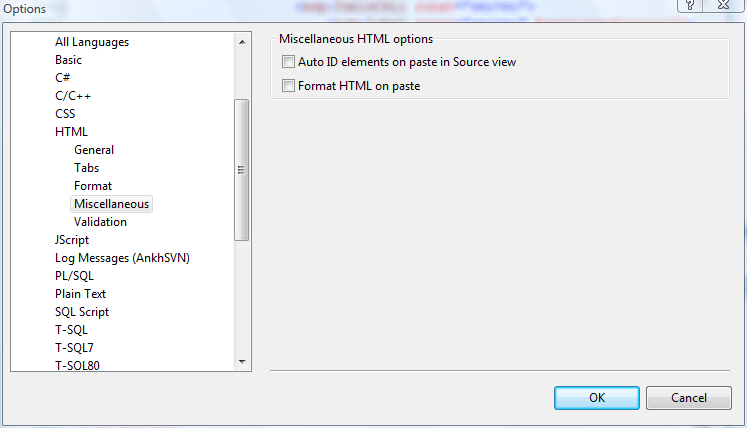
Whenever something has a runat="server" tag Visual Studio wants to attach an ID to it.
But there is no point to attach IDs to every cell/row in table!

So, if you're writing everything by hand, you don't need to specify the ID attribute, so everything is fine. But once you want to copy&paste that code, Visual Studio will instantly attach IDs to everything (with meaningful names as "Table1, TableRow1" etc..), and that's something I find very annoying when having to create large forms or something like that.

I mean, you have code like this:

<asp:Table runat="server">
    <asp:TableRow runat="server"></asp:TableRow>
</asp:Table>

and once you hit CRTL+V it get's obscured like this:

<asp:Table ID="Table1" runat="server">
    <asp:TableRow ID="TableRow1" runat="server"></asp:TableRow>
</asp:Table>

Now, being a thoughtful developer who likes tidy markup, I'm now going to remove these useless Ids from my code once again.

Oh, and did I mention that this also happens when you cut&paste? Nothing is more annoying than getting IDs injected when you're reordering table rows.

There is merit to the idea when you are copy&pasting real controls that have IDs attached, so you don't accidentally find yourself with multiple controls with the same ID. But when there is no ID attached to the code you're having in the clipboard, Visual Studio shouldn't be putting it in there.

Read more →

Session handling in ASP.NET

Often you need to save data to a user-central location (something like a global variable per user) and you immediately think of the session as the perfect place to store that data.
So you have this just retrieved user-id and you go:

Session["userid"] = userid;

And this works perfectly fine, ASP.NET will take care of the cookie handling etc while you can conveniently read from this field from now on.
But, there is one catch (as always):

Accessing session data is a very error prone process and should never left to the business code itself. Whenever a session times out you'll get NullPointerExceptions cluttered throughout your application (because reading from Session["userid"] will quietly return null if the session isn't there or got lost).
Working directly with the session also robs you of all the type-checking goodness we are all used to from .NET, so you may get some InvalidCastExceptions while accessing your objects too.


And, whenever you call Session["useid"] you're risking spelling mistakes what would lead to completely bogus data.

So, I hope you get my point, working with the session object directly is really nothing you'd want to do over and over again (and therefore risking errors every time).
It's usually much better to centralize this in one spot and test that well.


And centralizing this can be easily done through creating a custom class for this that will not only keep the session object away from you, but also provide you type-safe access to your data.

I suggest starting off with the session data object that we will use to store our data in:

[Serializable()]
public class UserSessionData
{
    public int UserId
    { get; set; }
}

Notice that I've put the Serializable() attribute onto the class so if you want to store the session in a state server or in sql server the CLR knows how to serialize the object and store it.
The whole object is solely responsible for keeping our UserId, nothing more nothing less.

And now we need to store this object in the session, for that purpose we could just incorporate static methods into the class that would retrieve and set the object to the current session.
Because we're working with ASP.NET here we want this UserSessionData to be accessible from within our ASP.NET Webform so it's pretty cool to just subclass Web.UI.Page and use it afterwards as the base class for our Webforms:

public class SessionHandler : System.Web.UI.Page
{
    private const string SESSION_NAME = "UserSession";
    public UserSessionData SessionData
    {
        get
        {
            UserSessionData sessionData = (UserSessionData)Session[SESSION_NAME];
            if (sessionData != null)
                return sessionData;
            else
                throw new Exception("Could not retrieve session state");
        }
        set
        {
            Session[SESSION_NAME] = value;
        }
    }
}

Now we only need to open our code-behind file and change it's superclass from Page to our SessionHandler (that just wraps Page):

public partial class _Default : SessionHandler
{
    protected void Page_Load(object sender, EventArgs e)
    {
        this.Title = this.SessionData.UserId.ToString();
    }   
}

Now whenever you need to read the UserId there is this neat property called SessionData that knows all about your user, while you don't need to do any is-null checks any more in your code, that's all handled by the SessionHandler class when accessing the session object :).

Hope this helps!

Read more →